Health & Safety
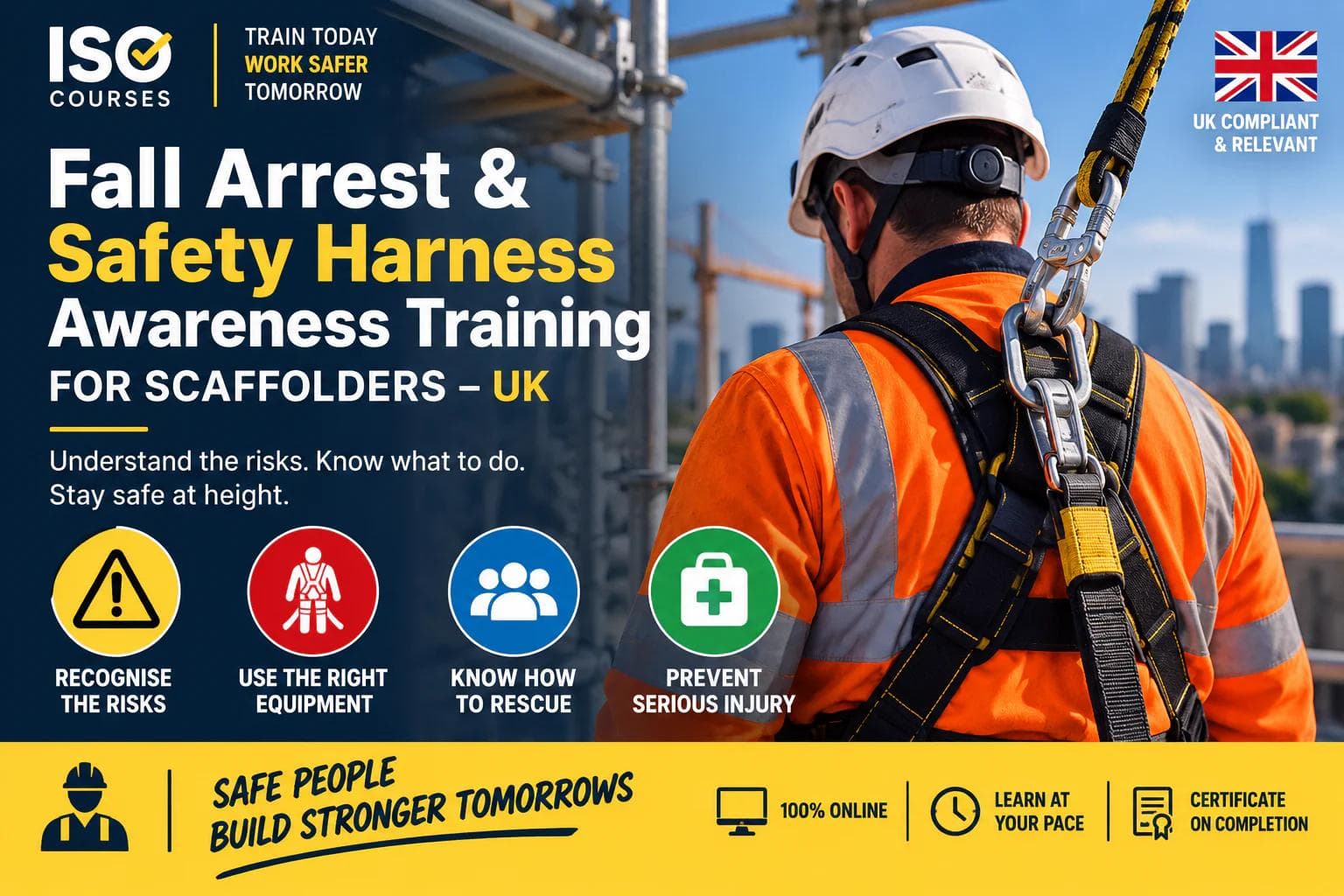
Fall Arrest & Safety Harness Awareness Training for Scaffolders
About the course
Online E-Learning — Working at Height, Harness Care & Suspension Risks (Great Britain)
This is an awareness-level working at height training course written specifically for scaffolders and scaffolding operatives working in Great Britain. It explains how falls are prevented on scaffolding, what a full body harness and energy-absorbing lanyard actually do, how to check, fit, clean and store fall arrest equipment, and what has to happen in the minutes after a fall has been arrested.
The course is built on the Work at Height Regulations 2005, current Health and Safety Executive guidance, and the fall prevention principles set out in NASC SG4:22 for scaffolding operations. Every safety claim in the course is traceable to a named source, and those sources are listed in the course materials.
The central message runs through all three modules: prevent the fall first. A harness is part of the system, not the first line of defence.
Course outline
Three modules covering fall protection on scaffolding, harness care and storage, and the health risks of suspension in a harness. Each module can be taken on its own or as part of the full programme. Every module ends with its own 10-question assessment.
Fall Arrest & Safety Harness Awareness for Scaffolders
Approx. 20 minutes · 10 questions · 80% pass mark. Core awareness covering fall prevention, the protection system, harness fitting, inspection and rescue.
Harness Cleaning, Care & Storage
Approx. 15 minutes · 10 questions · 80% pass mark. Supplementary awareness on keeping fall arrest equipment fit for use.
Suspension in a Harness: The Health Risks
Approx. 15 minutes · 10 questions · 80% pass mark. Supplementary awareness on motionless suspension, warning signs, rescue and casualty care.
Delivery methods
Around 1 hour · 3 modules · Awareness level · available through online delivery. Pricing starts from £20, with options for individuals, teams and workplace delivery where available.
Online e-learning — start immediately and complete at your own pace. Three modules, around one hour, with assessment and certificate. £20 per person.
Detailed course guidance
Why harness and fall arrest awareness training matters
Falls from height remain one of the biggest causes of death and serious injury in construction. Scaffolders are exposed more than most trades, because every lift starts out unprotected — and that is the moment the risk is highest.
The Work at Height Regulations 2005 set out a hierarchy that must be worked through in order: avoid work at height where you can, prevent falls where you cannot, and minimise the distance and consequences of a fall where a fall can still happen. Personal fall arrest sits in that last step. A great deal of harness misuse on site comes down to workers not understanding where the harness sits in that order — or believing that wearing one is enough on its own.
Employers also carry duties to provide suitable equipment and keep it in good repair under the Personal Protective Equipment at Work Regulations 1992 (as amended), and to inspect equipment exposed to conditions causing deterioration under the Work at Height Regulations. Awareness training helps demonstrate that workers have been given information and instruction about the equipment they are asked to use.
Important: awareness training limitations
It does not make anyone a competent scaffolder, a competent person for equipment inspection, a rescuer or a first aider.
It does not replace CISRS training, practical instruction, supervision, or the risk assessment and method statement for a specific job.
It is not legal advice, and it is not accredited, approved or endorsed by HSE, NASC, CISRS or any other body.
It does not certify equipment or authorise anyone to inspect fall arrest equipment as a competent person.
Course structure at a glance
Three modules covering fall protection on scaffolding, harness care and storage, and the health risks of suspension in a harness. Each module can be taken on its own or as part of the full programme. Every module ends with its own 10-question assessment.
1. Fall Arrest & Safety Harness Awareness for Scaffolders — approx. 20 minutes — 10 questions · 80% 2. Harness Cleaning, Care & Storage — approx. 15 minutes — 10 questions · 80% 3. Suspension in a Harness: The Health Risks — approx. 15 minutes — 10 questions · 80% Total (all modules): around 1 hour — 30 questions overall
Module 1 — Fall Arrest & Safety Harness Awareness for Scaffolders
The core module. Covers the legal hierarchy for working at height, the difference between restraint and fall arrest, the components of a personal fall protection system, fall protection on scaffolding using NASC SG4 principles, fall clearance and swing falls, pre-use checks, harness fitting, and what must happen if a fall is arrested. Includes three scenario-based case studies.
Welcome, scope and awareness-level limitations What work at height means and why scaffolders are exposed The avoid, prevent, minimise hierarchy Collective protection before personal protection Work restraint versus fall arrest Know your harness: the rated attachment points Anchor, connector, lanyard, harness — the complete system The scaffolders' safe zone and advance guardrail principles Safe versus unsafe attachment on a scaffold Erecting, altering and dismantling Case study: the incomplete scaffold Where you clip on and why anchor height matters Fall clearance — is there enough room below you? Swing falls and the pendulum effect Your pre-use check: look at it and feel it Case study: the damaged lanyard Fitting your harness in six steps Three levels of inspection, and the one hard rule If a fall happens — the arrest sequence The rescue plan: four things you must know Case study: the suspended worker Golden rules summary 10 multiple-choice questions · 80% pass mark · unlimited attempts
Module 2 — Harness Cleaning, Care & Storage
A supplementary module on keeping fall arrest equipment fit for use. Covers what degrades webbing and rope, safe cleaning and drying, dirt versus chemical contamination, correct storage, hard-to-spot damage, inspection intervals, and when equipment must be withdrawn from service.
What degrades webbing and rope Why a 1 mm cut matters The rules behind looking after your kit Cleaning: washing it without wrecking it Wet kit: drying it properly every time Contamination: dirt or damage? Storage: where it lives between shifts UV, heat, chemical attack and ground-in grit Case study: the end of a wet shift Pre-use, detailed and interim inspections Inspection intervals in arduous environments When equipment must come out of use Case study: the unreadable ID label Eight rules for looking after your kit 10 multiple-choice questions · 80% pass mark · unlimited attempts
Module 3 — Suspension in a Harness: The Health Risks
A supplementary module on what happens after the fall has been arrested. Covers motionless suspension, warning signs, why rescue cannot wait for the emergency services, what a rescue plan must contain, and correct handling of the casualty once they are down.
The fall is over — the danger is not What happens to the body while they hang Warning signs to act on immediately Why waiting is not an option Three things that help while the rescue happens What a rescue plan must contain Your role in the site rescue plan Case study: he says he is fine After the rescue: first aid and 999 An old myth worth correcting Reporting the incident and near misses Case study: he came round Equipment withdrawal after a fall Eight things to remember 10 multiple-choice questions · 80% pass mark · unlimited attempts
Assessment
10 questions per module 4 options per question 80% pass mark (8 of 10) Unlimited retakes Practical understanding, not regulation-number recall
Questions test what you would do on a lift. Several are visual, comparing two working situations to identify which worker is better protected.
Course format
100% online e-learning Learn at your own pace Around one hour total Desktop, tablet and mobile Modules available separately Certificate of completion on passing module assessments
A certificate of completion confirms you have passed the awareness assessments. It is not a competence card, CISRS qualification, or licence to inspect equipment.
Standards and sources
Content is summarised in original training language. Learners are directed to work to the current version of each document, to the manufacturer’s instructions for their own equipment, and to their own site’s arrangements. The HSE does not approve commercial training courses — this course is aligned to named UK sources, not “HSE approved”.
Legislation
WAHR 2005 — The Work at Height Regulations 2005 PPE at Work 1992 — Personal Protective Equipment at Work Regulations 1992 (as amended) CDM 2015 — Construction (Design and Management) Regulations 2015
HSE guidance
INDG401 — Working at height: a brief guide HSG33 — Health and safety in roof work — Appendix 3 and emergency rescue procedures INDG367 — Inspecting fall arrest equipment made from webbing or rope
Industry guidance
NASC SG4:22 — Preventing Falls in Scaffolding Operations NASC TG20 — Tube and fitting scaffold guidance CISRS — Scaffolding training and card scheme (referenced; not a substitute for CISRS)
Learning outcomes
On completion, learners will be able to:
Who should take this course
Online safety harness and fall arrest training for scaffolders and anyone issued with fall arrest equipment on scaffolding work in Great Britain.
Core audience — fall protection on scaffolding, harness use and rescue awareness.Trainee scaffolders and labourers working at height
Foundational awareness before and alongside practical site instruction.Scaffolding supervisors and chargehands
Setting expectations for safe zones, attachment and equipment condition.Site managers and contracts managers
Understanding duties, hierarchy of control and rescue planning for scaffolding work.Health and safety advisers and coordinators
Reference on Work at Height Regulations, PPE duties and NASC SG4 principles.Anyone required to wear a fall arrest harness at work
Pre-use checks, fitting, care and what happens after an arrest.Employers refreshing site-wide working at height awareness
Information and instruction evidence for workers issued with fall arrest equipment.New starters as part of site induction
Short online modules suitable for induction or toolbox delivery.
Accreditation and certification
The course is delivered by experienced NDC trainers and supports practical competence in the relevant subject area. Delegates receive confirmation of completion and can use the learning to support internal competence, audit readiness and management system improvement.
Continue your ISO route
Use these routes to compare the course with the wider certification path and related training options.
Frequently asked questions
Is safety harness training a legal requirement in the UK?
There is no regulation that names a specific harness training course. However, the Work at Height Regulations 2005 require that work at height is carried out by people who are competent, and that everyone involved is given adequate information, instruction and training. If your workers are issued with fall arrest equipment, you need to be able to show they have been trained to use it. Awareness training is one part of meeting that.
How long does the course take?
Around one hour for all three modules including the assessments. Module 1 takes about 20 minutes, and Modules 2 and 3 about 15 minutes each. Each module can be taken separately.
Does completing this course make me a competent person?
No. This is awareness-level training. It does not make you a competent scaffolder, a competent person for equipment inspection, a rescuer or a first aider, and it is not a substitute for CISRS training, practical instruction or supervision.
What is the difference between fall restraint and fall arrest?
Work restraint is set up so that you physically cannot reach a position from which you could fall — the fall never happens. Fall arrest does nothing until you have already fallen; it stops you before you strike something, but leaves you suspended and needing rescue. Where restraint can be used instead of arrest, it is the better option.
Where should a fall arrest lanyard be attached on a harness?
To a rated attachment point — the sternal (chest) point or the dorsal D-ring between the shoulder blades. Side D-rings are for work positioning, not fall arrest. Gear loops are for carrying tools and will tear under load. Always follow the manufacturer’s instructions and the safe system of work for the job.
How often should a safety harness be inspected?
The user carries out a pre-use check every time. In addition, HSE recommends a recorded detailed inspection by a competent person at least every six months for equipment made from webbing, rope or textiles. For frequently used lanyards in arduous environments — and HSE names scaffolding as one — it suggests increasing this to at least every three months. Anchors and metalwork are examined at least every 12 months.
What is suspension trauma, and how quickly does it happen?
It is the harm caused by hanging motionless in a harness. The leg muscles stop pumping blood back to the heart, so blood pools in the legs and less reaches the heart and brain. It affects people who are not injured at all. HSE does not publish a survival time, and no figure should be treated as a safe window — anyone showing warning signs, or unconscious, must be rescued as soon as it is safely possible.
Does the course cover NASC SG4?
Yes. Module 1 covers the SG4 principles that matter to an operative: the scaffolders’ safe zone, creating protection ahead of the work using advance guardrail methods, and personal fall protection as a back-up rather than the primary control. Principles are summarised in original training language.
Can a harness that has arrested a fall be used again?
No. A lanyard that has arrested a fall should never be reused. The whole system is withdrawn from service immediately, and no element goes back into use until it has had a detailed examination or been replaced in line with the manufacturer’s instructions.
Can the course be delivered to a whole team or site?
Yes. The modules are available for online delivery, and group licences and site-wide delivery can be arranged. Assessments can also support supervised on-site or toolbox delivery where your organisation needs that format.